
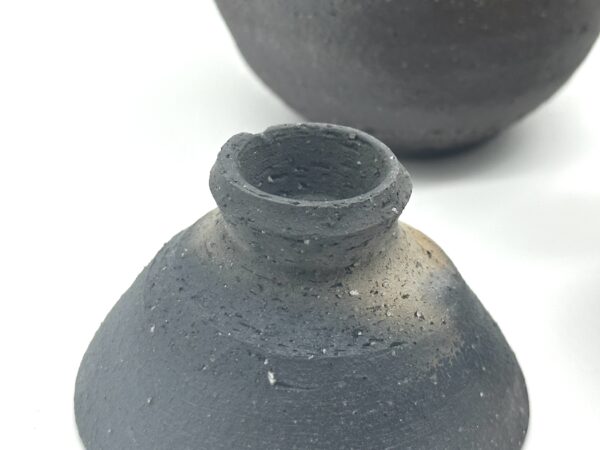

Shigaraki Charcoal Sake Set
$ 91.35
Description Carbonising Kiln Moduration happens when there is a minimum oxygen supply to kiln after pumping extra oxygen to raise the temperature to very high point. By doing so, fire searches all possible oxygen by going deep inside the pottery itself. This allows much deeper carbonization of actual pottery by slowly raising the temperature and produce extra hard, beautiful looking Shigaraki piece. Please soak it in water for a couple of hours and air dry it prior to use to prevent cracking. It will acquire deeper and shinier complexity on its appearance as you use it, and it is a part of Shigaraki’s charm. Shigaraki ware (信楽焼) is a stoneware pottery made in Shigaraki area, Japan. The kiln is one of six Ancient Kilns in Japan. The kiln and local pottery tradition has a long history. The name Shigaraki describes a collective group of ceramic products made in the surrounding area. Shigaraki ware is said to have begun when tiles were constructed for the Emperor Shōmu’s Shigaraki-no-miya Palace in 742. However, some old ruins were found from back to the Kamakura period and early in the Muromachi period. It is suggested that Bizen potters may have immigrated to Shigaraki and began producing works there because early Shigaraki wares appear to have some similarities with Bizen pottery. The town of Shigaraki was formed up of eighteen independent communities along the Daido River in the valley in the most southern tip of Shiga prefecture, some may even date back to 1278. The communities were Kamagatani, Minami Matsuo in Nagano, and Goinoki in Koyama, which said to have been the center of the Shigaraki industry in the old days. Shigaraki kilns were used for private potters. The Shigaraki wares were first produced to meet the demands of farmers, making mortars, water urns, bottles, and deep dishes, many of which were simple, incised, and with geometric lines that is evidence that the wares were produced for everyday agricultural use. The main characteristic of Shigaraki ware is due to the local sandy clay from the bed of Lake Biwa with a warm orange color, and makes very strong pottery. The ceramics have irregular lines and an ancient look. Firing technique shifted from reduction to oxidation firing, which allows free flow of air during the firing rather than limited air flow into the kiln. This allows iron oxidation to happen which helps as a part of the coloring process. This way of firing is possible due to an anagama kiln, which is used to fire Shigaraki ware. The term anagama means “cave kiln” in Japanese, as these were usually made into the side of hills. Anagama has a single chambered structure with a sloping tunnel shape. This firing must be done at high enough temperatures to fire the clay. Anagama also helps to achieves the shiny and slightly sparkly mineral glaze effect, which are so popular with Shigaraki wares.




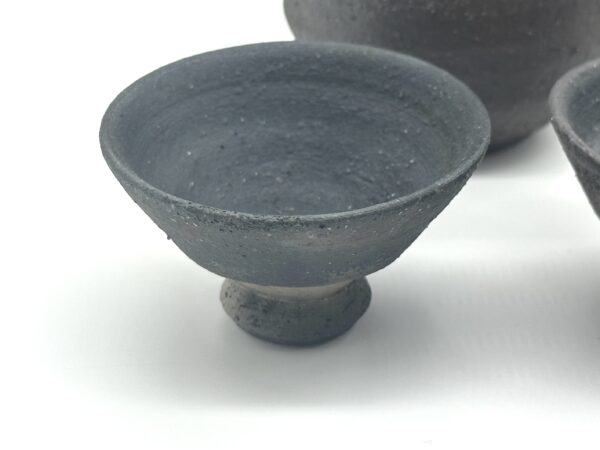 Shigaraki Charcoal Sake Set